The artist
Born in 1968, sailor for fifteen years, sculptor of mineral inspiration.
The journey
Born in Grenoble in 1968, Franck Roux grew up in a small village in Savoie. At sixteen, he left the mountains for the naval school, then the maistrance. The army did not keep him: he resigned, passed his baccalaureate as an independent candidate during his military service, and began a first year at university. But the call of the open sea won. He left alone for seven months in South America.
In Chile, he worked in a shipyard building a racing prototype. He was not a sailor, but the yard invited him to sail. He discovered that he did not suffer from seasickness — a revelation. He took part in his first regatta, the Mil Guías, then returned to France. Hired aboard La Margot (17 metres), he rose from crew member to skipper. Fifteen years of sailing followed.
In 2006, he landed in Belle-Île-en-Mer. Love kept him on the island. He first tried ceramics — the experiment did not last, but the creative gesture was launched. To earn a living, he built wooden houses, then founded a landscaping company. Working with matter, vegetation and mineral became his daily life.
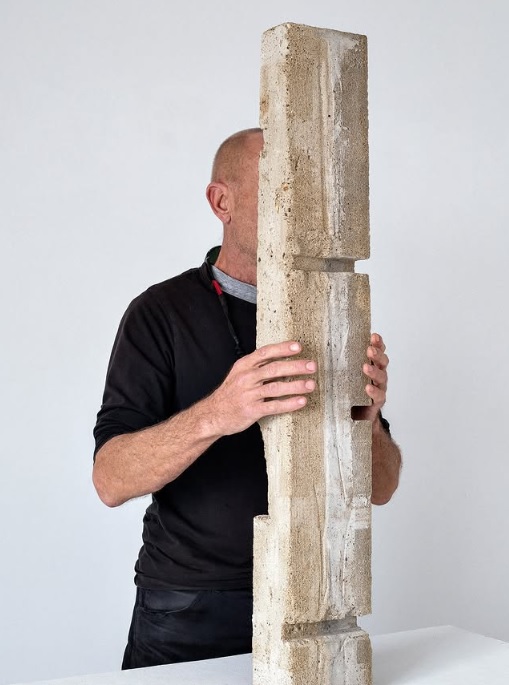
In 2024, on a friend's advice, he began sculpting. Concrete — different sands, different cements — became his material. Pyramids, obelisks, meteors, magmas: he shapes luminous forms, smooth or fissured, like so many frozen eruptions. He also photographs, in black and white, capturing the island's light with an eye sharpened by fifteen years of gazing at the horizon.
The studio
Franck Roux's studio is a space of confrontation with matter. No large machinery, just repeated gestures, mixes of sand and cement, moulds, worn tools. Each sculpture is born from an impulse, followed by a long time of setting, drying and finishing.
Photography accompanies him in this same relationship with the mineral. The same gaze laid upon a rock, a shadow, a trace. The camera extends the hand's gesture: grasping what resists, what endures.

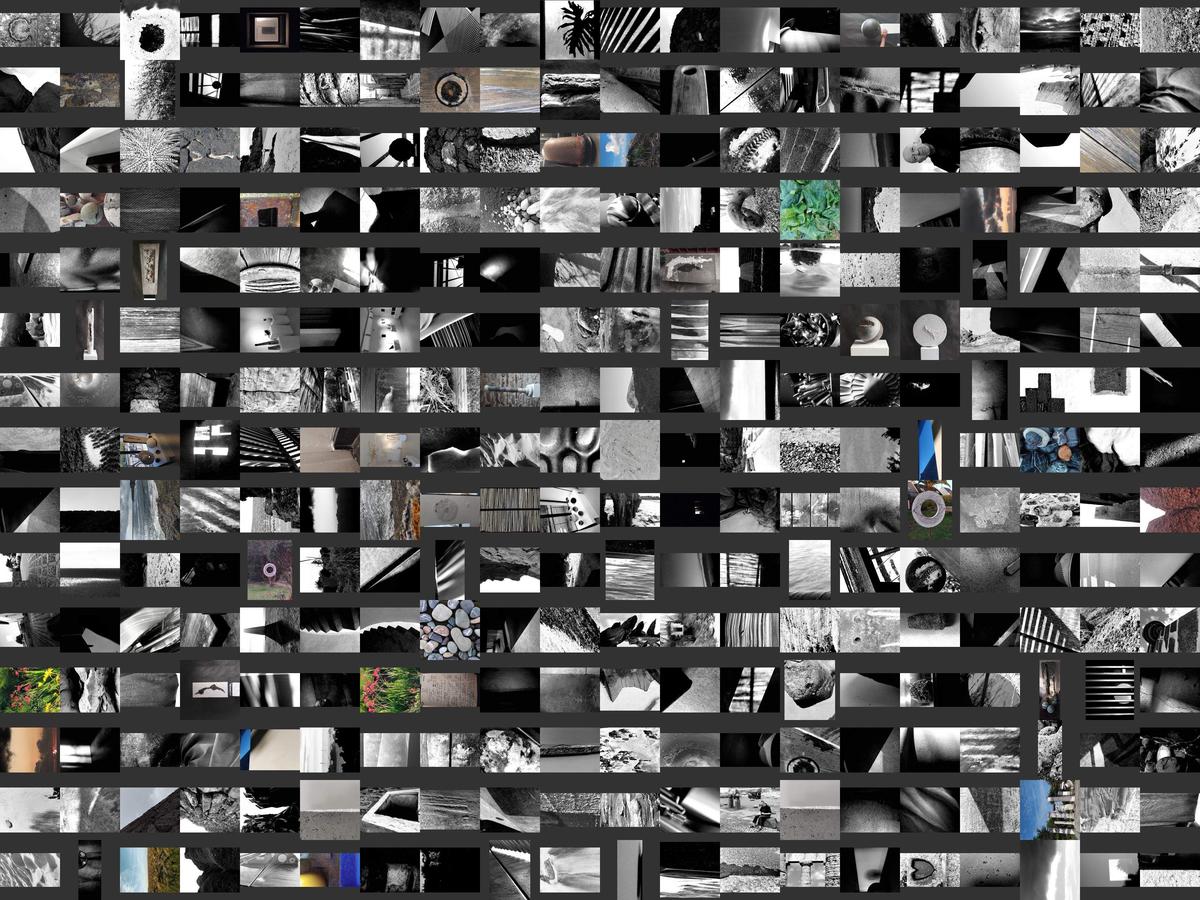
2,904 photographs
“My work is born from the relationship between the mineral and light. I mix sands and cements that I find here and there, and I seek a pictorial quality: a surface that reflects, that absorbs, that lives according to the hour of the day.”
The site as matter
2,904 gazes
The site you are browsing is built from the same matter as the works: thousands of photographs, fragments of light, textures of concrete and island. Each page draws from this visual corpus. The design is not a wrapper: it is an aggregate, like concrete.